#4 - Four Famous Jelly Fungi in One Day! (6.5.25)
On May 9th, I took a great hike through part of the Carolina Thread Trail (a trail stretching throughout North and South Carolina) and found over a dozen notable species of fungi. Somehow, some of the four most well-known jelly fungi were found all in this one short trail section! These include the amber jelly roll, snow fungus, witches’ butter, and the wood ear. For this blog post, I will use these beautiful, slimy fungi to describe what it means to be a jelly fungus.
Jelly fungi, as per their name, are gelatinous fungi that typically take on an asymmetrical, globular shape. When dry, these fungi are rubbery and may even seem dried up, but after rain, they are slimy and seem to gain volume due to rehydration. Common genera (a classification of species contained within a family) of jelly fungi are Auricularia, Dacrymyces, Exidia, Pseudohydnum, Sebacina, and Tremella (Elliot, T. & Stephenson, S., 2018). These jelly fungi genera are typically of one of three families: Auriculariaceae (Auricularia, Exidia, Pseudohydnum genera), Dacrymycetaceae (Dacrymyces genus), and Tremellaceae (Sebacina, Tremella genera). These three families would seem to be within very similar taxa due to their morphological similarities. However, they only share a relationship through their phylum: Basidiomycota. Auriculariaceae is found within Agaricomycetes (class) while Tremellaceae and Dacrymycetaceae are found within the classes Tremellomycetes and Dacrymycetes, respectively (Catalogue of Life). This would make ‘jelly fungi’ a paraphyletic group. These fungi are such a wonder to find, but research is limited (even compared to other basidiomycetes). Due to such limits, it is important to keep in mind that the phylogenies of the three groups are likely to change as genetic analysis studies come out.

The amber jelly roll (Exidia recisa) of family Auriculariaceae (Agaricomycetes) is found in clusters on fallen deciduous tree debris, acting as a decomposer of the cellulose. Generally known as Exidia, the amber jelly roll fungus and others within the genus are the only brown-to-black jelly fungi (Elliot, T. & Stephenson, S., 2018). This makes the ID of an exidia species particularly easy. In North Carolina, I find them almost every week year-round except for the summer. If anyone ever spots one of these, I would recommend taking it (including the wood substrate) home to watch it dehydrate and rehydrate before and after rain cycles. Although it seems delicate, the ability to rehydrate is an incredible adaptation that it uses to stay active for long periods of time.

My favorite from this list, the snow fungus (Tremella fuciformis), is not only the most majestic fungus I have ever discovered, but it is also one of the few fungi that parasitizes another fungus group: the Annulohypoxylon genus of Ascomycota. In fact, I noticed the Annulohypoxylon species before I noticed T. fuciformis (below)! The snow fungus, like other jelly fungi, is gelatinous and slimy. However, unlike most other jelly fungi, it does not have irregular clumps within the large clump; instead, it is more compact with folds. Compared to other white jelly fungi, such as the white jelly fungus (Sebacina pululahuana), it is translucent instead of opaque (Elliot, T. & Stephenson, S., 2018). This fungus can be found all over the world, and it is even cultivated for medicinal and culinary purposes in China (The Mycelium Emporium, 2017).

Next, witches’ butter (Tremella mesenterica) is likely the most infamous jelly fungus in foraging communities today, pictured below. It is gelatinous and slimy (like Exidia spp.), with bright yellow irregular folds. Ecologically, it decomposes fallen deciduous tree logs. Notice that it is another species from the Tremella genus; although morphologically similar, both T. fuciformis and T. mesenterica have very different ecological lifestyles (Elliot, T. & Stephenson, S., 2018). This difference is possible in such closely related species due to the osmotrophic feeding mechanism (to send powerful enzymes to digest outside of the organism) that allows a fungus to easily adapt to gaining nutrition from living or dead organisms. Many fungi can break down some of the most indigestible substances, such as lignin and cellulose. Osmotrophy is one of the reasons that fungi are some of the best parasites and decomposers on Earth.

Finally, the wood ear (Auricularia fuscosuccinea) is morphologically different from the previous three jelly fungi. One difference is that instead of being moist and slimy when hydrated, it is instead rubbery. Then, once it dehydrates, it appears shriveled up. These fungi form very distinct, singular, down-turned “ears” that aggregate as multiple fruiting bodies. Also, the fruiting bodies of the Auricularia are much bigger (up to three inches) than other jelly fungi. Overall, the wood ear is very easy to identify as within the Auricularia genus; however, many people get it and the aforementioned Exidia recisa confused due to color similarities. The wood ear is found in southeastern North America from spring to fall on deciduous tree sticks (Elliot, T. & Stephenson, S., 2018). I found the wood ear thrice, actually! Note that one picture appears to be of a living tree. However, it is only a dead branch stuck in the tree.
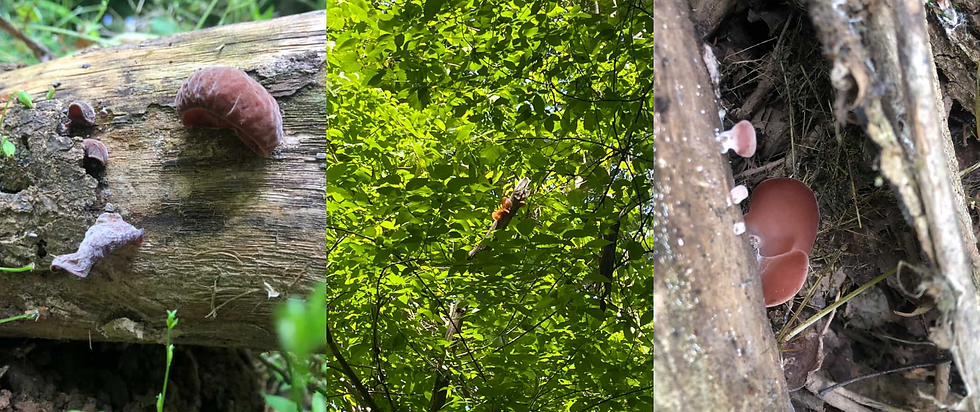
These wonderful jelly fungi are stunning and infinitely interesting. With gene sequencing technologies, it will be interesting to see how the classification of these taxa evolves. Their adaptations, including the ability to dehydrate and rehydrate, showcase the wonderful diversity of fungi. Thank you for reading this blog post and supporting my endeavors to learn and educate!
References:
Black fungus (Annulohypoxylon Sp.). (2017). The Mycelium Emporium. https://www.themyceliumemporium.com/product-page/black-fungus-annulohypoxylon-sp
Browse the Catalogue of Life. (2025). Catalogue of Life. https://www.catalogueoflife.org
Todd F. Elliot & Steven L. Stephenson. (2018). Mushrooms of the Southeast. Workman Publishing.


Comments