#1: Neighborhood Earthstar Confusion (3.31.25)
During a walk through my neighborhood in late March, I spotted some small earthstars on a lawn far from some deciduous trees. Earthstars are a monophyletic group of puffball-like basidiomycetes genetically close to stinkhorns and bird’s nest fungi. The main morphological difference between earthstars and puffballs is that earthstars have triangular flaps resembling a star, whereas puffballs do not. These flaps can be flat against the ground, but they are sometimes curved up or down. The earthstars I found were about 2 inches in total radius, and the spore ball was about 1 inch in radius. They all appeared to be in late maturity and had very tough, yet smooth triangular flaps (each had about 8-10) curved around the spore ball. At this mature stage for this species, the spore ball is light brown, and the star flaps are dark brown. Lastly, there is a small perforation at the top of the spore ball for releasing spores as the spore ball experiences pressure from raindrops or other physical disruptions. This perforation resembled slits, almost like someone had punctured a worn-down basketball

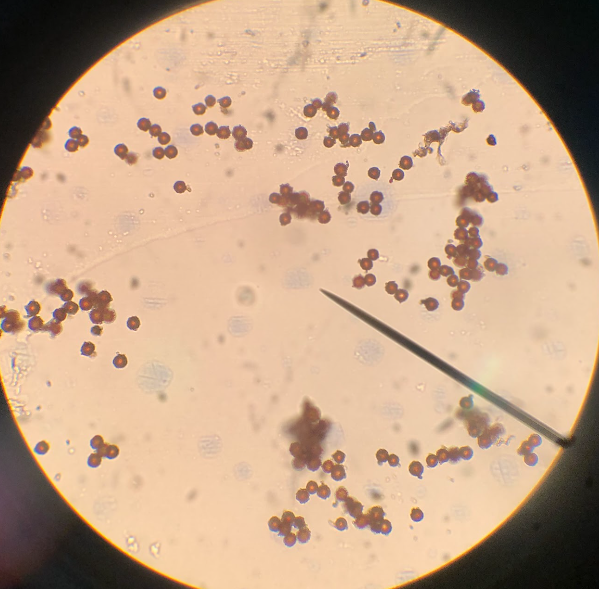
I collected the youngest appearing earthstar and put it in a small jar. I gathered spores by reaching into the spore ball with forceps and placed them on a slide, dry. Using a compound light microscope with 40X magnification, I observed the spores to be dark brown (as they appear without the magnification) and spherical. There may have been small imperfections in the spherical shape, like bumps or points, but the magnification of my microscope did not go farther and the resulting images were slightly blurry. Understanding the general characteristics like size, color and shape of the spores greatly helps to narrow down the species of a fungus.
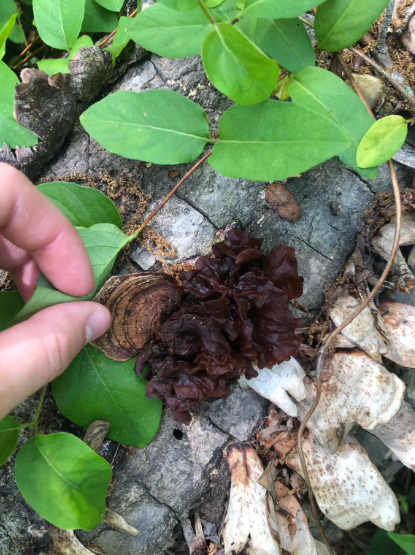
After further researching puffball-like fungi and earthstars, I found that there are “true” and “false” earthstars, both within Basidiomycete class of Agaricomycetes. The first group, “true” earthstars, are more diverse than “false” earthstars. Geastraceae, the “true” puffball family, is within order Geastrales, noted by their puffball shape with a round, bottom protrusion that is sometimes split into a star formation. The spore ball is created through a separation of outer fruiting body tissue from the inner sporeball. The “true” earthstars from Geastrum are typically very fleshy. Examples of “true” earthstar species include: collared earthstar (Geastrum triplex), sessile earthstar (Geastrum fimbriatum), and dwarf earthstar (Geastrum schmidelii). Some “true” earthstars, like G. schmidelii, have very adapted, beak-like and striated mouths on the sporeballs instead of normal, slit-like perforations. Next, “false” earthstars are from order Boletales, family Sclerodermataceae, which makes them closely related to tough earth balls that resemble puffballs. Individuals within Sclerodermataceae typically have a hard and scaly outer-covering (noted below) and are mycorrhizal with deciduous trees. More specifically, “false” earthstars are found within the 9-species genus Astraeus. The most well-known Astraeus species is the barometer earthstar (Astraeus hygrometricus), and I highly consider it as a possible identification match with my earthstar. On the left of the image below are depictions of “true” earthstars from family Geastraceae and on the right, family Sclerodermataceae (which includes earth balls and "false" earthstars). I think that after taxonomical clarification of the identifying features between Astreaus and Geastraceae, it is most likely that my specimen is a member of one of genus Astraeus’ nine species.

Of the nine species of Astraeus, only 4 are found in and around North Carolina, and only A. pteridis does not feature white patches on the stars. Although there may be variations with each North Carolinian species that would invalidate my ID, it seems most plausible for my specimen to be identified as Astraeus pteridis within the Sclerodermataceae family, Boletales order, and Agaricomycetes class.
SOURCES:
DK (2013). Mushrooms: How to Identify and Gather Wild Mushrooms and Other Fungi. DK Publishing.
Elliott, T., & Stephenson, S. (2018). Mushrooms of the Southeast. Timber Press.

Comments